
A busy phone can hide an empty schedule. One caller wants a service you stopped offering. Another lives outside your travel area. A third needs a start date you cannot meet. Meanwhile, a homeowner who was a good fit submitted a form on Friday and never heard back.
Contractor lead generation gets more useful when you can see these differences. The goal is a steady flow of projects your team can assess, price and deliver well, supported by a process that shows where opportunities are being lost.
This guide gives you a practical way to build that process. You will define a qualified inquiry, choose a manageable channel mix, connect marketing to your estimating capacity and create a weekly review that produces decisions. The worksheets and examples are planning tools, not promises about what your company will earn.
Start with the work your business actually wants
Before choosing an advertising platform, write down the jobs you want to take on during the next planning period. Be specific about the service, area, size and timing.
“More remodeling leads” is difficult to act on. “Kitchen remodeling inquiries from homeowners within our normal operating area who are planning work for the next available production window” gives your team something concrete to discuss. It also exposes questions that advertising cannot answer for you.
Do you want full renovations, smaller upgrades or both? Will you provide design? Which parts of a project do you subcontract? Can your estimator evaluate all the inquiries you hope to attract? What happens when a project requires a specialty your crew does not handle?
Create a short service-fit statement for each priority offer:
- We help this type of customer.
- We perform this specific category of work.
- We normally serve these locations.
- Our process starts with this step.
- These projects are outside our current scope.
- Our present scheduling constraints are these.
Keep the statement factual. Do not label the company a specialist in work it has barely performed. Do not advertise immediate availability unless someone is responsible for keeping that claim current.
A clear definition also helps referral partners. A supplier, former customer or complementary trade can recommend you more accurately when they know what you want. “We are taking bathroom renovations in these neighborhoods” gives them more direction than “Send anything our way.”
Revisit this definition when crew capacity changes. The best inquiry in a quiet month may be the wrong project when the same team is committed to a complicated installation. Qualification should reflect your operation, rather than a fixed marketing label that nobody updates.
Define a qualified inquiry before you count one
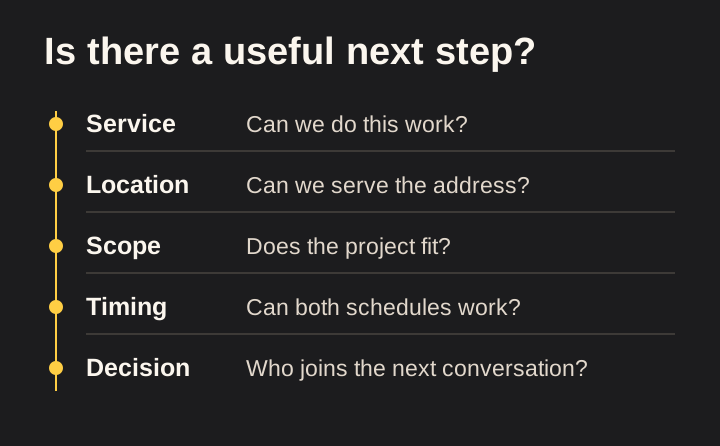
A submitted form is an inquiry. It becomes qualified when you have enough information to judge whether there is a reasonable next step for both sides.
Use five practical checks: service, location, scope, timing and decision process. A prospect does not need a perfectly prepared brief. The checks are there to guide a useful conversation, not to make people prove they deserve attention.
Service
Can you perform the requested work? Be careful with broad labels. “Roofing” may include repairs, replacement, commercial systems and insurance-related projects. A business that only handles some of those requests should distinguish them in its website copy and intake process.
Location
Can you serve the address under your normal operating model? A distant project might still make sense, but it should be a deliberate exception. Avoid letting the estimating team discover geography after arranging an unnecessary visit.
Scope
Does the project look compatible with the way you work? Scope can include job size, technical complexity, material requirements and the customer's expectations. Use a preliminary conversation to identify uncertainty rather than forcing an exact budget too early.
Timing
Is the customer's schedule compatible with yours? An urgent request may be valuable for an emergency service company and unsuitable for a booked remodeling crew. State response hours and scheduling limitations honestly.
Decision process
Who needs to participate in the next conversation? For residential work, there may be several owners. For commercial work, a property manager may need approval from another person. Ask who should receive the estimate, without making assumptions about authority from a person's title or identity.
A simple classification is enough to start: fit confirmed, more information needed, unsuitable, or unreachable. Record why. “Unsuitable: outside service area” tells marketing what to change. “Bad lead” does not.
Google Ads itself distinguishes qualified leads from converted leads and allows advertisers to define deeper steps using their own lead process. That distinction reinforces an important measurement principle: an initial contact and a later business outcome should not be treated as interchangeable. Google Ads: qualified and converted leads
Draw the whole customer path
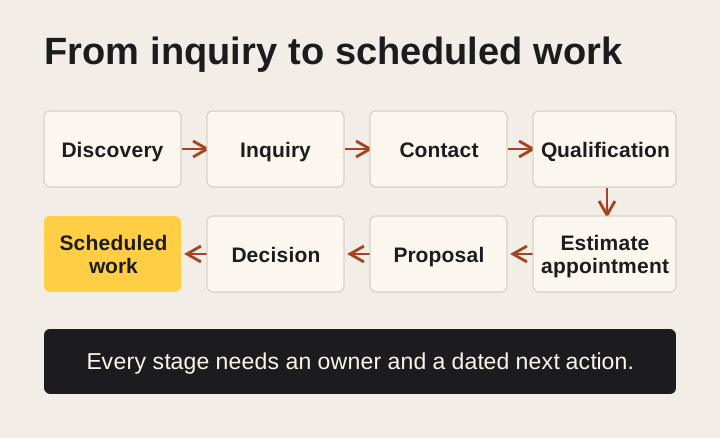
Use one sheet of paper or a shared document to map these stages:
Discovery → inquiry → contact → qualification → estimate appointment → proposal → decision → scheduled work.
Your actual process may be shorter. A small repair may move from a call to a booked visit without a separate proposal. A large renovation may require design and preconstruction steps. Keep the map close to reality.
For each stage, record an owner, the information needed and the next action. If an inquiry moves from an office coordinator to an estimator, specify what the handoff includes. If nobody owns follow-up after a proposal is sent, that gap belongs on the map.
Consider a fictional fence contractor. A homeowner finds a service page, sends a project description and receives a confirmation. The coordinator checks location and general scope, then assigns a site visit. The estimator prepares the proposal. After that, everyone assumes someone else is checking whether the customer has questions.
The marketing report can show successful form submissions while the business loses track of open proposals. More traffic will not repair that handoff. Assigning an owner and a next-action date might be the more useful first change.
Also record where information gets duplicated. If someone types the same address into three systems, the process has more opportunities for error. You do not need an elaborate automation project to improve it. Start by establishing one reliable record and a clear rule for updates.
Ask a person who was not involved in designing the process to follow a sample inquiry. Can they explain where it is now, who is responsible and what happens next? If they cannot, the process probably depends too heavily on someone's memory.
Find your current bottleneck
When the schedule is inconsistent, resist changing every channel at once. Look for the earliest stage where good opportunities are consistently failing to progress.
| What you observe | What to inspect first | A sensible first action |
|---|---|---|
| Few relevant inquiries | Visibility and offer clarity | Check how priority services are described and discovered |
| Many out-of-area inquiries | Targeting and service-area wording | Tighten location settings and explain coverage |
| Good inquiries but little contact | Notifications and ownership | Assign a primary owner and backup |
| Conversations but few appointments | Fit, expectations and next steps | Review intake questions and appointment process |
| Appointments but few proposals | Estimating workflow | Identify missing information and internal delays |
| Proposals but few decisions | Clarity and follow-up | Ask what information customers still need |
| Won jobs that strain margins | Scope and acquisition economics | Review which work marketing attracts |
This table is a diagnostic prompt, not a verdict. A low appointment rate could reflect poor fit, unavailable scheduling or a measurement error. Read a small set of actual records before deciding what to fix.
Include successes in the review. If one type of project moves smoothly through the process, study the conditions around it. Was the service page clearer? Did a referral partner explain the process beforehand? Was the customer already familiar with the company? Those differences can suggest useful tests.
Avoid turning individual anecdotes into universal rules. One difficult customer does not prove a channel is poor. A single large job does not prove the campaign is profitable. Keep the story, but compare it with the rest of the period.
Build a focused channel mix
A small contractor does not need to run every available channel. Choose a manageable combination that reflects existing demand, available proof, budget and response capacity.
Make referrals easier to give
Start with customers and professional relationships that already know your work. Explain your current service focus and make it easy to share accurate contact information. A short project description, useful service page and clear inquiry method can help the person making an introduction.
Keep the request respectful. Do not pressure a customer to recommend work they have not evaluated. Separate a referral conversation from any request for a public review, and check the applicable rules before offering incentives.
Track referrals by source when people are comfortable sharing that information. A simple “How did you hear about us?” question can reveal useful patterns, although memory is imperfect. Preserve uncertainty rather than forcing every inquiry into a confident attribution label.
Improve local discovery
For eligible businesses, an accurate Google Business Profile is one part of being discoverable locally. Google describes local results in terms of relevance, distance and popularity or prominence, and says complete, accurate business information helps it understand a business. Paying for advertising does not buy a better local ranking. Google Business Profile: local ranking
Your practical task is to make the real business clear: the services offered, appropriate business category, operating details and authentic evidence of work. A profile should agree with the website and with what the office tells callers.
Do not expect a list of service areas to remove geographic limitations. Build your operating plan around places you can genuinely serve. Review the current Business Profile rules before changing addresses, categories or business names.
Use the website to answer buying questions
A service page should help a prospective customer understand whether you perform the work, where you do it, what the first step involves and why your claims are credible.
“Quality service at a fair price” leaves most questions unanswered. Explain your process in concrete terms. If site conditions affect an estimate, say what you need to inspect. If a consultation precedes a detailed proposal, explain the sequence.
Use genuine project material where permission exists. A project explanation can be more informative than a gallery alone: what the customer needed, what constraints existed, what work was completed and what the photos actually show.
Add one paid channel when you can learn from it
Paid advertising is easier to evaluate when the offer, landing page and intake process already make sense. Choose a defined service and geography rather than launching everything at once.
Write down the purpose of the test. For example: determine whether a particular service can attract qualified estimate requests within an affordable acquisition range. Set a spending limit, decide how results will be recorded and identify the person who will review search terms and inquiry quality.
Treat the test as an experiment. A campaign can fail because of targeting, messaging, the destination page, response handling or economics. Your records should make those explanations distinguishable.
Match the landing page to the promise
When an advertisement describes a specific service, the destination should continue that conversation. A homeowner looking for a deck replacement should not have to search a general homepage to discover whether you do that work.
Begin with a direct description of the service and coverage area. Follow with evidence, the process and a clear next step. Include important limitations before they become a surprise.
Use the same language your customers use when it is accurate. Trade terminology can be useful, but explain unfamiliar terms. Someone requesting a bathroom renovation may not know how to describe waterproofing, substrate preparation or fixture relocation. Your job is to make the conversation easier.
A useful page can contain:
- A concise explanation of the service.
- The types of projects you accept.
- Relevant locations or coverage guidance.
- Genuine project examples.
- A description of the estimating process.
- Answers to common scope and scheduling questions.
- A visible phone number and accessible inquiry form.
You do not need a special keyword density. Place the main topic naturally in the title, opening and relevant headings, then answer the reader's questions. Google's content guidance emphasizes usefulness, originality and satisfying the reader's purpose; it explicitly rejects the idea of a preferred word count. Google Search Central: helpful content
A page that receives fewer but better-matched requests can be valuable. Evaluate the result through qualification and booked work, not just its ability to persuade everyone to click a button.
Make intake short enough to use and detailed enough to help

Ask only for the information you need to decide the next step. For many contractors, that means name, preferred contact method, project location and a short description. A service dropdown can help when the options are understandable.
An optional photo may help with initial assessment, but it should not replace an inspection where one is needed. Explain that photos support a preliminary conversation and are not a guarantee that you can diagnose the work remotely.
Be thoughtful about asking for budget. A range can identify a mismatch early, but an unexplained question may make a customer feel they are setting their own price. If you ask, say why: to understand the scale of work and recommend an appropriate next step. Include an option for uncertainty when that is compatible with your sales process.
Tell people what happens after submission. Use a response expectation the team can actually meet, including any limitations outside business hours. Do not promise instant callbacks unless you can deliver them.
Test the form yourself on a phone. Submit it, confirm that the record arrives and check the notification seen by the responsible person. Then test the failure conditions: missing fields, invalid email address, upload problems and a temporary connection interruption.
A successful submission message is not proof that the office received the inquiry. Verify both sides. Repeat the test after website updates, form changes and notification changes, because the customer path includes every system between the browser and the person answering.
Give every inquiry a next action
A pipeline becomes useful when records contain decisions. Every active inquiry should have a named owner, current stage and next action with a date.
The next action should describe something a person can do. “Follow up” is vague. “Call to confirm whether the site visit time works” or “Send the revised scope after estimator review” is more useful.
Create a simple response workflow:
- Check whether the message is genuine and whether it belongs to an existing record.
- Confirm service and geography.
- Respond through the appropriate channel.
- Record important scope or timing information.
- Agree on a next step.
- Assign responsibility and timing.
- Close the record when the customer declines or the project no longer fits.
Use automation to support this workflow, especially notifications and reminders. Keep a person responsible for unusual requests and meaningful decisions. An automated acknowledgment should not pretend that an estimator has reviewed a project when that has not happened.
Respect communication preferences and obtain the consent required for the channels and messages you use. Requirements vary by jurisdiction and message type. Do not assume that submitting an estimate form grants unrestricted permission for promotional calling or texting.
Make stopping easy. If someone says the project is paused, record that rather than continuing a generic sequence. A smaller, accurate pipeline is more useful than a large collection of stale opportunities.
Measure cost at the right stages
Start with a small set of metrics that you can define consistently:
- Total inquiries received.
- Genuine new inquiries after removing spam and duplicates.
- Qualified inquiries.
- Estimate appointments.
- Proposals sent.
- Jobs won.
- Marketing cost associated with the period or cohort.
Cost per inquiry equals relevant marketing cost divided by inquiries. Cost per qualified inquiry uses qualified inquiries as the denominator. Customer acquisition cost uses acquired customers, with a clearly stated definition of which costs are included.
Keep media-only cost separate from fully loaded marketing cost. A report that divides advertising spend by leads is answering a different question from one that includes management, creative production and supporting software.
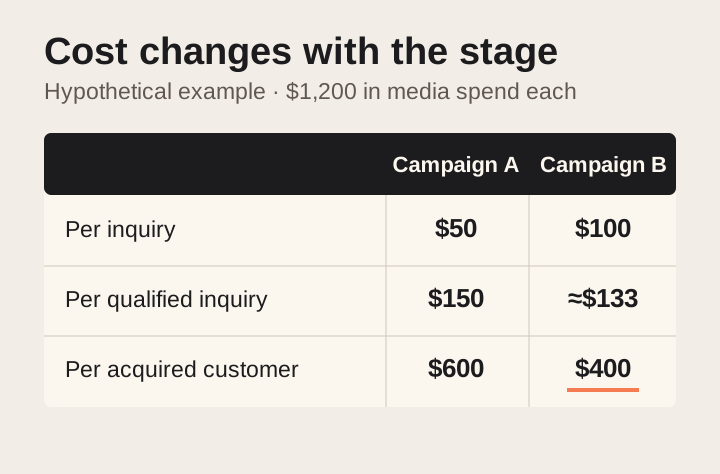
Here is a deliberately hypothetical example. Campaign A costs $1,200 and produces 24 genuine inquiries, of which eight qualify and two become customers. Media cost per inquiry is $50, cost per qualified inquiry is $150 and media cost per acquired customer is $600.
Campaign B costs $1,200 and produces 12 genuine inquiries, of which nine qualify and three become customers. Its corresponding figures are $100, about $133 and $400. The second campaign looks more expensive at the inquiry stage and less expensive at the customer stage.
Those figures do not prove B is the better investment. You still need job value, delivery costs, time to close and confidence that the records are complete. The example shows why the first number cannot answer the whole business question.
Do not count unsigned proposals as earned revenue. Track projected work separately from contracted work, completed work and collected revenue. Each stage answers a different planning question.
Avoid misleading attribution
A customer might see your truck, hear about you from a neighbor, search your name and then click an advertisement. No single report necessarily captures the whole path.
Record the measurable source and the customer's stated source separately when practical. If they disagree, keep both rather than rewriting one to make a dashboard look cleaner.
Use consistent campaign naming and tracking conventions. Make sure the office can distinguish a new inquiry from an existing customer's service request. Deduplicate repeated forms and calls about the same project so one interested person does not appear to be several new opportunities.
For long sales cycles, compare cohorts. A group of inquiries received this month may not reach a decision until later. Dividing this month's spend by this month's wins can mix unrelated activity and produce misleading swings.
Google Ads supports qualified and converted lead goals based on offline progression, but implementation requires accurate definitions, reliable data and appropriate privacy practices. Treat platform integration as a later layer on top of a trustworthy internal process, not a substitute for one. Google Ads: qualified and converted leads
If the data is incomplete, say so. “Source unknown for six inquiries” is a useful operational finding. A confident chart built from guessed sources is not.
Connect the pipeline to crew and estimating capacity
Lead generation has a capacity cost before a job is sold. Calls, site visits, measurements, supplier questions and proposal preparation all take time.
Estimate how many new opportunities your team can realistically handle. If each preliminary visit requires travel and preparation, a sudden increase in appointments may overwhelm the estimator before production capacity becomes the issue.
Separate two questions: how much work can you sell, and how much estimating effort can you support? A company may have crew availability but too little administrative support to respond consistently.
Use a rolling view of capacity. Record committed projects, likely start windows and major constraints. Share a concise version with whoever manages marketing so offers do not become detached from operations.
When capacity tightens, adjust deliberately. You might reduce spend on lower-priority services, clarify the next available start period or focus on projects that fit upcoming gaps. Avoid simply leaving campaigns unchanged while the team stops responding.
When capacity opens, first review existing qualified opportunities whose timing may now fit. Do not assume they are still interested. Ask respectfully, update the record and avoid treating old inquiries as guaranteed future work.
Run a weekly pipeline review
A useful review can be short if the records are current. Bring marketing, intake and estimating together around the same questions.
What arrived? Which inquiries fit? Where did good-fit prospects stall? Which promises were difficult to keep? What should change next week?
Look at reasons, not just totals. An increase in out-of-area inquiries may call for targeting changes. Repeated questions about minimum project size may call for clearer copy. A cluster of missed notifications may call for a technical fix.
Choose one or two changes and assign owners. Keep a change log with the date, reason and intended result. If you change the page, campaign and follow-up process together, learning which change mattered becomes difficult.
Also ask what should stay the same. A process that is working does not need constant reinvention. Preserve useful routines so the team can compare periods without continually changing definitions.
A practical first-month plan
During the first week, define priority services and qualification criteria. Audit recent inquiries, identify missing information and draw the actual customer path.
During the second week, repair the most obvious intake or website problem. Make sure calls and forms reach the right person. Clarify service areas, response expectations and next steps.
During the third week, strengthen one discovery channel. That could mean improving a relevant service page, organizing referral information or preparing a tightly scoped paid test. Choose according to the bottleneck you found.
During the fourth week, review the records and the quality of the process. Check whether classifications are consistent, whether active inquiries have next actions and whether your team can explain the results.
This is a suggested implementation sequence, not a claim that marketing produces a measurable return in thirty days. Some changes can be inspected immediately; business outcomes may take longer. The first month should leave you with a clearer system and better evidence for the next decision.
Frequently asked questions
What is a qualified contractor lead?
It is an inquiry that meets your business's practical fit criteria and has a reasonable next step. Those criteria usually include service, geography, scope, timing and a workable decision process. Define them before comparing channels.
Should contractors buy leads or build their own marketing?
Evaluate both against the same outcomes. Purchased leads require scrutiny of sharing, age, fit, billing and dispute terms. Your own marketing requires ongoing work and investment. Neither category guarantees profitable projects.
How many inquiries does a contractor need?
Work backward from capacity and your own observed progression rates. If those rates are unknown, use a clearly labeled planning scenario and update it with actual records. Avoid borrowing another contractor's conversion rate as a promise.
What should a small contractor fix first?
Start with the earliest significant bottleneck supported by evidence. If appropriate inquiries are arriving but nobody responds reliably, fix intake before increasing spend. If the process works but few relevant people discover the business, focus on visibility and offer clarity.
Build a pipeline you can explain
A steadier pipeline starts with clear decisions about the work you want, the customers you can serve and the process you can support. Marketing then has a specific job: help the right people discover you and make the next step understandable.
Define fit, connect the stages and keep the records honest. That gives you a better basis for choosing channels, improving the website and deciding when more advertising is justified.
If you want help identifying where qualified inquiries are getting lost, discuss your current customer path with Loskutech. Bring a few anonymized examples and the questions your team keeps hearing. Start with the bottleneck that matters most.
Explore our marketing and acquisition services for the work and review process behind this approach.