

The first question is not whether Google Ads or local SEO is better. It is what your contracting business needs next and whether the customer path is ready to support it.
A company with available crews, a clear service offer and reliable intake may be ready to test paid search. A company with inaccurate business information, weak service pages and no way to track inquiries may need to repair those foundations first. Another business may already receive good organic inquiries and need a focused campaign for one new service.
Google Ads and local SEO can support the same business in different ways. This guide explains the trade-offs, the costs that belong in the comparison and a decision process for choosing a sensible starting point. It does not assume a universal budget, cost per click or timeline to booked work.
Define the business problem before choosing a channel
Write down the work you want to attract, the area you can serve and the capacity available to assess and deliver it.
“More leads” is too broad. Do you need emergency service calls, scheduled maintenance, larger renovation projects or commercial inquiries with a longer decision process?
Specify the timing. A short-term gap in the schedule creates a different problem from building visibility for the next year. Neither channel can guarantee that customers will arrive exactly when a crew becomes available.
Then identify the current bottleneck. Are suitable people failing to discover the business, or are existing inquiries failing to progress? A channel change will not necessarily solve a slow response process, unclear scope or uncompetitive proposal.
Review a small set of recent opportunities. Where did they come from? Which fit? What happened next? If the answers are unknown, basic measurement may be the first investment.
This preparation prevents a common mistake: selecting the channel that sounds attractive before defining what it needs to accomplish.
Understand what you are comparing
For this article, Google Ads primarily means paid search campaigns that show advertisements in response to relevant searches. Other Google advertising products and campaign types have different mechanics and should be evaluated separately.
Local SEO means work that helps a legitimate local business be understood and discovered through unpaid search experiences. It can include accurate business information, useful service pages, technical website basics, relevant proof and appropriate local presence.
Local SEO is not a single switch, and Google Ads is not simply a way to purchase a position permanently. Both require choices, maintenance and realistic expectations.
A Google Business Profile is also not the same thing as the website. A business may have a useful profile and weak service pages, or a strong site with inaccurate profile information. Inspect both.
Keep Local Services Ads distinct when discussing options. Eligibility, setup and charging models differ from standard search campaigns. Do not transfer assumptions about one product to another without checking current documentation and availability.
The useful comparison is between specific plans: what work will be performed, what it costs, what can be controlled and how the result will be evaluated.
Compare the channels on practical dimensions
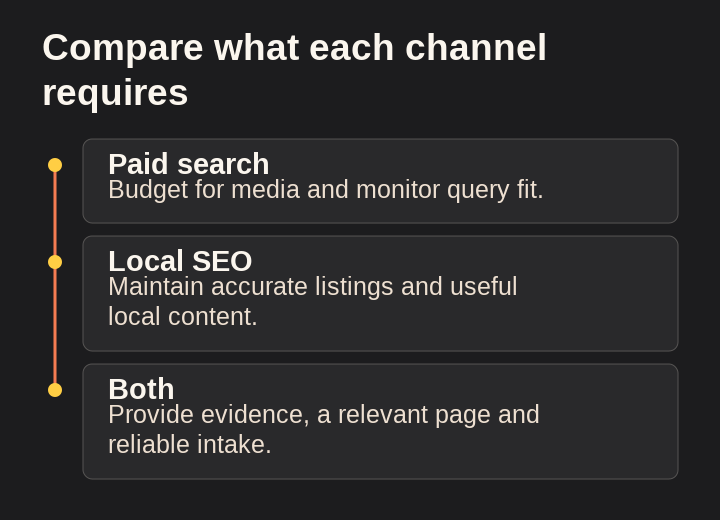
| Dimension | Paid search | Local SEO |
|---|---|---|
| Main investment | Media plus setup, management and destination-page work | Website, content, profile and ongoing improvement work |
| Control | Campaign targeting, messages, budgets and settings within platform limits | Accuracy, usefulness, technical quality and legitimate business evidence |
| Timing | Can begin generating eligible ad exposure after setup and approval | Changes may take time to be discovered and reflected |
| Ongoing work | Query review, budget oversight, creative, measurement and lead-quality review | Content maintenance, technical checks, profile accuracy and evidence |
| Main risk | Paying for traffic that does not become suitable work | Investing in work that does not improve relevant visibility or inquiries |
| Shared dependency | A clear offer, credible destination and reliable intake | A clear offer, credible destination and reliable intake |
This comparison does not imply that one channel always produces faster customers or a lower acquisition cost. Results depend on the market, service, competition, execution and business process.
Use the table to ask better questions of a proposed plan. A provider should explain what they will do within each category rather than selling a channel as inherently superior.
Check the foundation both channels need

Before increasing either investment, inspect the service page and contact process.
Can a visitor understand the service and coverage? Is the proof authentic? Does the page explain the first step? Do calls and forms reach a responsible person? Can the team distinguish a genuine new inquiry from spam or an existing-customer request?
If those basics fail, more exposure can create more confusion and workload without improving the pipeline.
You do not necessarily need a complete redesign. A clear service page, working contact path and accurate business information may be a more appropriate initial scope.
Test the form and phone route yourself. Confirm the saved record, notification and office ownership. A successful website animation or thank-you message is not proof that the inquiry reached the team.
Review mobile usability. Paid and unpaid visitors both need to read the content, use controls and understand errors.
Keep the foundation work visible in the budget comparison. It is easy to make a channel look cheaper by excluding the website and intake improvements it depends on.
When a paid-search test may make sense
Paid search may be worth testing when the business has a defined service, a plausible market, room to handle inquiries and money it can afford to spend learning.
The offer should be specific enough to match a search and a destination page. A broad campaign for every service across a large region can make it difficult to understand what is working.
The team should be able to respond consistently during the periods the campaign is intended to generate contact. If calls arrive when nobody can answer or follow up, the test measures an incomplete process.
The business also needs a realistic view of acquisition economics. A high-value invoice does not automatically justify high advertising cost. Materials, labor, travel, estimating effort and overhead still matter.
Treat the first campaign as a bounded experiment. Define the service, geography, spending limit, measurement method and review owner before launch.
Paid search can provide observable information about queries and inquiries, but it does not guarantee enough data to reach a confident conclusion quickly. A low-volume service or long sales cycle may require patience and a narrower definition of what the test can teach.
When local SEO foundations deserve priority
Local SEO work may deserve the first investment when basic business information is inaccurate, important services are poorly explained or the site is difficult to navigate and use.
Start with information the business can control. Make sure services, contact details, hours and coverage are accurate. Build useful pages for genuine offers and connect them to relevant evidence.
For eligible businesses, maintain the Business Profile according to Google's rules. Google says local ranking depends mainly on relevance, distance and popularity or prominence, and that there is no way to pay for a better local ranking. Google Business Profile: local ranking
That means paid advertising should not be sold as a purchase of organic local position. It also means a contractor cannot control every factor affecting who sees the business.
Prioritize useful improvements rather than a long checklist of low-value activity. Correcting a confusing service page may matter more to the customer than publishing another generic article.
Keep the effort focused on real business questions. Local SEO should make the company easier to understand and evaluate, not create an artificial version of the business for search engines.
Be realistic about timing
Paid campaigns can begin serving after setup, approval and eligibility requirements are met, but exposure is not the same as qualified inquiries or booked work.
The business still needs suitable searches, a relevant offer, a persuasive destination and follow-through. A campaign launched today does not create a guarantee of next week's schedule.
SEO changes also take time to be reflected. Google's starter guidance explains that effects can take from hours to several months, suggests waiting weeks to assess changes and warns that not every improvement produces a noticeable search impact. Google Search Central: SEO starter guide
Use separate milestones for implementation and outcomes. “The service page is complete and tested” is an implementation milestone. “The page produces qualified inquiries at an acceptable cost” is a business outcome.
A provider should be able to commit to work within their control without promising a ranking or customer count they do not control.
If your need is urgent, say so clearly. The responsible recommendation may include operational or sales actions beyond these two channels rather than pretending either one can guarantee immediate work.
Compare full costs, not only media spend
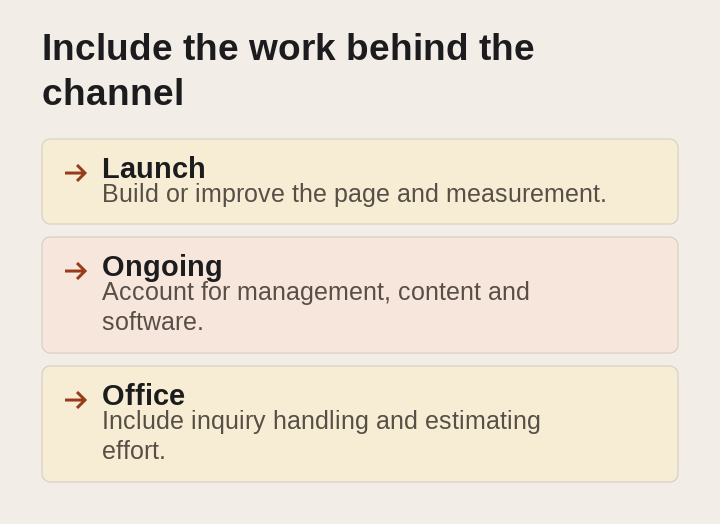
Paid search costs can include research, account setup, tracking, landing-page development, media, management and creative updates. Some plans bundle these; others separate them.
Local SEO costs can include research, technical work, service-page writing, project documentation, profile maintenance and ongoing review. The absence of a charge per click does not make the work free.
List one-time and recurring costs separately. A website improvement may support both channels, so explain how it is allocated rather than counting it twice or omitting it entirely.
Include the team's time. Responding to inquiries, preparing estimates, approving content and gathering project evidence all consume capacity.
Ask vendors what is excluded. Does the quoted fee include a usable landing page? Who fixes tracking problems? Is content based on verified business information? Who owns the accounts and assets?
Do not compare a comprehensive plan with a media-only number as though they are equivalent. A clear scope comparison is more useful than the lowest headline price.
Understand advertising budget controls
An average daily budget is not always a hard daily cap. Google states that, for most campaigns, spending on a particular day can reach twice the average daily budget, subject to applicable spending limits. Campaign types and budget changes can affect the rules. Google Ads: spending limits
Before launch, review the current rules for the actual campaign and make sure the business understands the commitment. Do not assume that multiplying a daily figure by the remaining days always captures every billing detail.
Set a total test budget and decide who monitors it. Record what happens if spending or lead quality differs materially from expectations.
Separate the advertising-platform budget from management and other costs. A business owner should be able to see the total exposure.
Avoid changing budgets repeatedly without a reason and a record. If several settings change at once, it becomes harder to interpret the result.
A budget is a constraint and a planning tool. It is not a promise that the platform will produce enough suitable opportunities to justify it.
Use keyword research to test the opportunity
For paid search, keyword research should examine the language people use, the likely intent, the service area and the available forecast information.
Google's Keyword Planner provides keyword ideas and estimates. Its forecasts take factors such as bids, budget, seasonality and historical ad quality into account. Those are planning estimates, not guaranteed future results. Google Ads: Keyword Planner forecasts
Do not copy a national cost-per-click benchmark into a local budget and treat it as a quote. The actual service, geography, match behavior and competition matter.
Review current search results. A phrase may attract do-it-yourself readers, job seekers, suppliers or customers looking for a service you do not provide.
For local SEO, use research to identify useful service and customer-question coverage. Do not create a page for every phrase when several phrases represent the same decision.
Keep measured data and judgment distinct. If no reliable volume or cost data is available, label the terms as qualitative candidates and explain what remains to be validated.
The output should be a focused hypothesis about relevant demand, not a spreadsheet of phrases with no connection to the business.
Evaluate geography and service fit
Both channels need accurate coverage information, but they influence geography differently.
Paid campaigns provide targeting controls, subject to platform limitations and imperfect signals. Local search visibility is affected by the real business and the searcher's context, including distance.
Do not assume that adding a town to a profile or page guarantees visibility there. Likewise, do not assume that an advertising boundary prevents every out-of-area inquiry.
Confirm the project location during intake. A person searching may be away from the property they own or manage.
Consider service-location combinations rather than geography alone. A distant large project may fit while a small repair in the same place does not.
Use the website to explain practical limits. If the business considers certain projects outside normal coverage, state the condition accurately.
Review unsuitable-inquiry reasons. A rising out-of-area share may indicate a targeting or messaging problem. Requests for unavailable services may point to broad keywords or unclear page content.
Work backward from job economics
Use the economics of your own work to assess how much acquisition cost the business can support.
Start with a representative service and a realistic estimate of contribution after direct delivery costs. Then account for estimating and sales effort, overhead needs and the uncertainty of conversion.
A hypothetical example can clarify the logic. Suppose a completed job leaves $2,000 before marketing and general overhead under the company's chosen cost definition. Spending $1,500 to acquire that job leaves only $500 for the remaining obligations and profit. The invoice size alone does not show whether the campaign is sensible.
Now suppose only one in four qualified inquiries becomes a customer. That relationship affects what the business can afford per qualified inquiry, but it should come from actual records or be clearly labeled as an assumption.
Do not treat a planning conversion rate as a target the market must deliver. Test a range and see how sensitive the economics are.
Keep different services separate when their costs and sales cycles differ. A channel can work for one offer and fail for another without either conclusion applying to the whole business.
Use three realistic starting scenarios
Scenario one: the foundation is incomplete
A fictional remodeling company has attractive photos but unclear service descriptions, an unreliable form and no consistent follow-up owner.
Starting a broad campaign would make the source of poor results difficult to identify. A sensible first step is to repair the inquiry path, clarify the offer and establish basic measurement.
Local profile accuracy and useful service content can be addressed alongside that work. Paid testing can follow once the business can receive and assess requests reliably.
Scenario two: the business has a defined capacity gap
A fictional service contractor has a tested website, a responsive office and a specific service with available capacity.
A bounded search campaign may be worth evaluating, using a clear geography and qualification process. Local SEO maintenance should continue, but it may not be the only tool for the near-term question.
The test should measure genuine and qualified inquiries, not only clicks or call-button interactions.
Scenario three: organic demand exists but the offer is changing
A fictional contractor already receives relevant search inquiries and is adding a distinct service.
The first task is to explain and support the new offer with accurate content and proof. A focused paid test may help evaluate interest while longer-term visibility develops.
These scenarios are decision examples, not case studies or claims that a particular sequence always produces growth.
Design a paid test you can learn from
Write a short test brief. State the service, target area, customer intent, landing page, maximum spend and review conditions.
Identify the primary business outcome and supporting signals. Qualified inquiries may be the main early outcome, while search terms, contact actions and received inquiries help diagnose the path.
Record exclusions and boundaries. If the business does not perform certain work, make that clear in targeting and copy where appropriate.
Assign responsibility for campaign review and intake feedback. The advertising manager needs to know which requests fit and why others do not.
Avoid judging the test only by the platform's conversion column. Confirm what each conversion action measures and whether spam or duplicate contacts enter the count.
At review, separate execution problems from market findings. A broken form means the test was compromised. A functioning path with repeated unsuitable requests suggests a different issue.
Decide whether to continue, revise or stop based on evidence and the remaining uncertainty. Do not keep spending merely because the original plan called for a longer campaign.
Build an SEO plan around specific improvements
An SEO plan should name the problems being addressed and the evidence that the work was completed.
For a contractor, the initial scope might include correcting business information, improving important service pages, making navigation clearer and resolving technical obstacles to access or indexing.
Content should answer real questions and demonstrate the actual business. Approved project examples and clear process explanations can be more useful than generic articles produced to fill a calendar.
Keep the plan distinct from a guarantee of results. The provider can deliver an improved page and test its technical implementation. Search systems and customers determine the later response.
Review relevant visibility and inquiries over an appropriate period, with context for seasonality and other changes. Do not declare success solely because one keyword moved, or failure because a new page has not produced a job immediately.
Ask what will be maintained after the initial work. Services, hours, project evidence and technical systems change. An accurate site requires continued ownership.
Measure both channels with the same business definitions
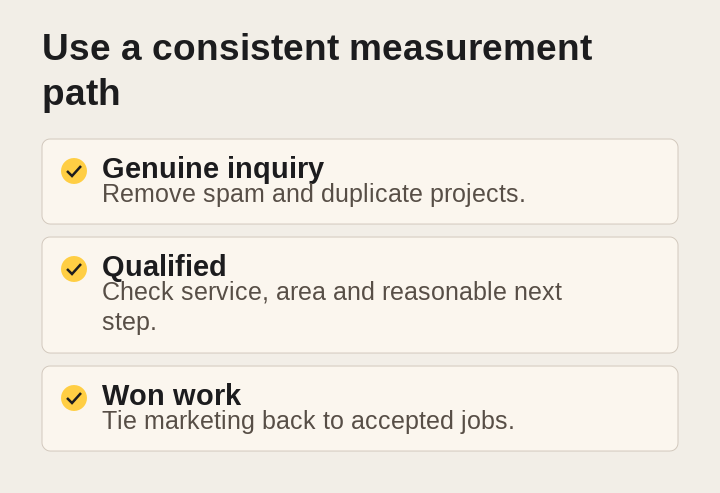
Use consistent definitions for genuine inquiry, qualified inquiry, appointment and won job. Otherwise, the channel comparison will be distorted.
Separate branded demand from new service discovery where practical. A person who already knows the company may behave differently from someone encountering it for the first time.
Keep technical attribution and customer-reported source separate. Neither necessarily describes the whole journey.
Compare costs on a transparent basis. Media-only acquisition cost and fully loaded acquisition cost answer different questions. State which you are using.
Account for the sales cycle. A campaign's inquiries may become customers in a later month, while SEO work may support several types of traffic over time.
Include unknowns. If source data is incomplete, the conclusion should reflect that limitation.
The purpose is not to crown a permanent winner. It is to decide where the next unit of effort and spending is most likely to address the business's current constraint.
Use a decision sequence rather than a fixed budget split
Begin with readiness. If the offer, website or intake is unreliable, fix the critical issue before scaling exposure.
Then consider timing and evidence. If there is a defined near-term opportunity and the business can afford a bounded test, evaluate paid search. If local information and service content are weak, prioritize those improvements.
Next, consider capacity. Do not create a campaign the office cannot support or a content program the owner cannot review.
Finally, consider learning. Choose a plan that will leave you with useful evidence, even if the first hypothesis is wrong.
There is no universal percentage split between ads and SEO. A fixed ratio can ignore the business's starting point, service mix and constraints.
Revisit the decision when the conditions change. A channel that deserves priority this quarter may need a smaller role later.
Plan for what happens when a channel is paused
Before committing to a plan, ask what remains if you reduce spending or change providers.
For paid search, identify the assets the business retains: account access, campaign history, landing pages, creative and tracking documentation. Confirm which tools or numbers depend on an ongoing subscription.
For SEO work, identify the pages, research, technical changes and approved project material delivered. Make sure the business can access and maintain them. A report alone is not a substitute for usable assets and documented work.
Do not assume that organic visibility will remain unchanged after active work stops. Competitors, search systems and the business itself continue to change. Equally, do not assume every useful asset disappears when a paid campaign is paused. A well-built service page can continue serving customers through other routes.
Create an exit checklist before it is needed. It should cover access, data export, open issues, recurring charges and responsibilities for keeping the customer path functioning.
This is particularly important when several systems are bundled together. Ending an advertising agreement should not unexpectedly disable the main inquiry form or leave the office without access to customer records.
Discuss these details neutrally. Clear ownership helps both the business and the provider work with fewer assumptions. It is part of evaluating the investment, rather than a sign that the relationship is expected to fail.
A channel plan should leave the company more capable of understanding its marketing. If every explanation depends on a proprietary score or an inaccessible dashboard, ask for clearer documentation before increasing the commitment.
Questions to ask before hiring help
Ask the provider what they would inspect before recommending a channel. A recommendation that arrives before any discussion of services, economics and intake deserves scrutiny.
Request a scope that separates media, management, website work, content and measurement. Clarify account ownership and access.
Ask what counts as a lead in their reporting. Find out how they handle spam, duplicates, out-of-area requests and long sales cycles.
Ask which outcomes they control and which they do not. Be cautious of guaranteed rankings, guaranteed profitability or unexplained lead-volume promises.
Request a test and review plan. What would cause them to change the approach? What evidence would justify increasing spend?
Finally, confirm how operational feedback reaches the marketing team. A channel plan is only as useful as its connection to the work the company actually wants.
Frequently asked questions
Is local SEO free?
There may be no media charge for an organic click, but research, content, technical work and maintenance have costs. Compare the full investment rather than only the platform fee.
Can Google Ads improve my organic local ranking?
Advertising does not buy a better local ranking. Paid and unpaid visibility should be evaluated as separate mechanisms, even when they support the same customer journey.
Should a new contractor start with ads?
Only after considering the offer, service capability, website, response process and available test budget. Being new does not automatically make one channel the correct choice.
Can I use both?
Yes, when the budget and team can support both coherently. Keep responsibilities, costs and measurement clear, and avoid spreading resources so thin that neither receives adequate attention.
Choose the next useful investment
Google Ads and local SEO are tools for a business plan. The right starting point depends on the work you want, the evidence you have and the customer path you can support.
Fix critical gaps, choose a focused objective and measure genuine outcomes. A clear, bounded plan is more useful than a confident claim that one channel always wins.
Tell Loskutech about your business to discuss your services, capacity and current inquiry path. The first decision should be where the next investment can do the most useful work.
Explore our marketing and acquisition services for the work and review process behind this approach.


